Backdrop for UK M&A in Q3 2026

UK M&A enters the second half of 2026 more selective than resilient. On Office for National Statistics (ONS) figures, 2025 closed with a powerful surge in inbound value — Q4 2025 inward deals reached £27.4bn, the highest since early 2021 — but Q1 2026 volumes then fell sharply to 352 completed deals, down from 495 the previous quarter. The story is no longer one of broad recovery: it is a two-speed market in which a handful of large, mostly foreign, transactions carry the value totals while underlying domestic activity stays subdued.
Market Tone: Fewer Deals, Bigger Cheques, Foreign-Led
The pattern that defined late 2025 has carried into 2026: deal counts are soft, but headline value is being propped up by a small number of very large, predominantly inbound transactions. Q4 2025 inward M&A of £27.4bn was driven almost entirely by a cluster of deals valued above £1bn, while domestic value fell to just £1.8bn. Then in Q1 2026 the combined number of majority-stake deals dropped to 352 from 495, with volumes lower across domestic, inward and outward flows alike.
Higher-for-longer financing costs, renewed energy-driven inflation risk and geopolitical uncertainty have lengthened processes and pushed buyers to be more forensic on earnings quality and downside protection. The Bank of England's own Agents reported through early 2026 that M&A activity "continues to be held back by uncertainty," with deals taking longer on the back of heavier due diligence and regulatory caution.
The market remains open to the right assets. Well-run SMEs with strong cash conversion, recurring revenues and defensible niches continue to transact at robust multiples, particularly where there is a clear strategic fit for trade or a buy-and-build platform. But the tolerance for anything cyclical, capital-hungry or story-led has narrowed considerably.
It is easy for an owner to read a two-speed market and assume their business is on the slow side of it. Often the opposite is true. The softness is concentrated in cyclical, capital-hungry and story-led businesses; well-run SMEs with strong cash conversion, recurring revenue and a defensible niche are still transacting at robust multiples — frequently with more competitive tension than the headline volumes would suggest, because quality assets are scarcer when overall activity cools. A quieter market can mean less competition for a good business, not more.
The ONS data below show how deal volumes have normalised well below the 2021 peak, even as the value and share of inbound foreign acquisitions have climbed to multi-year highs.
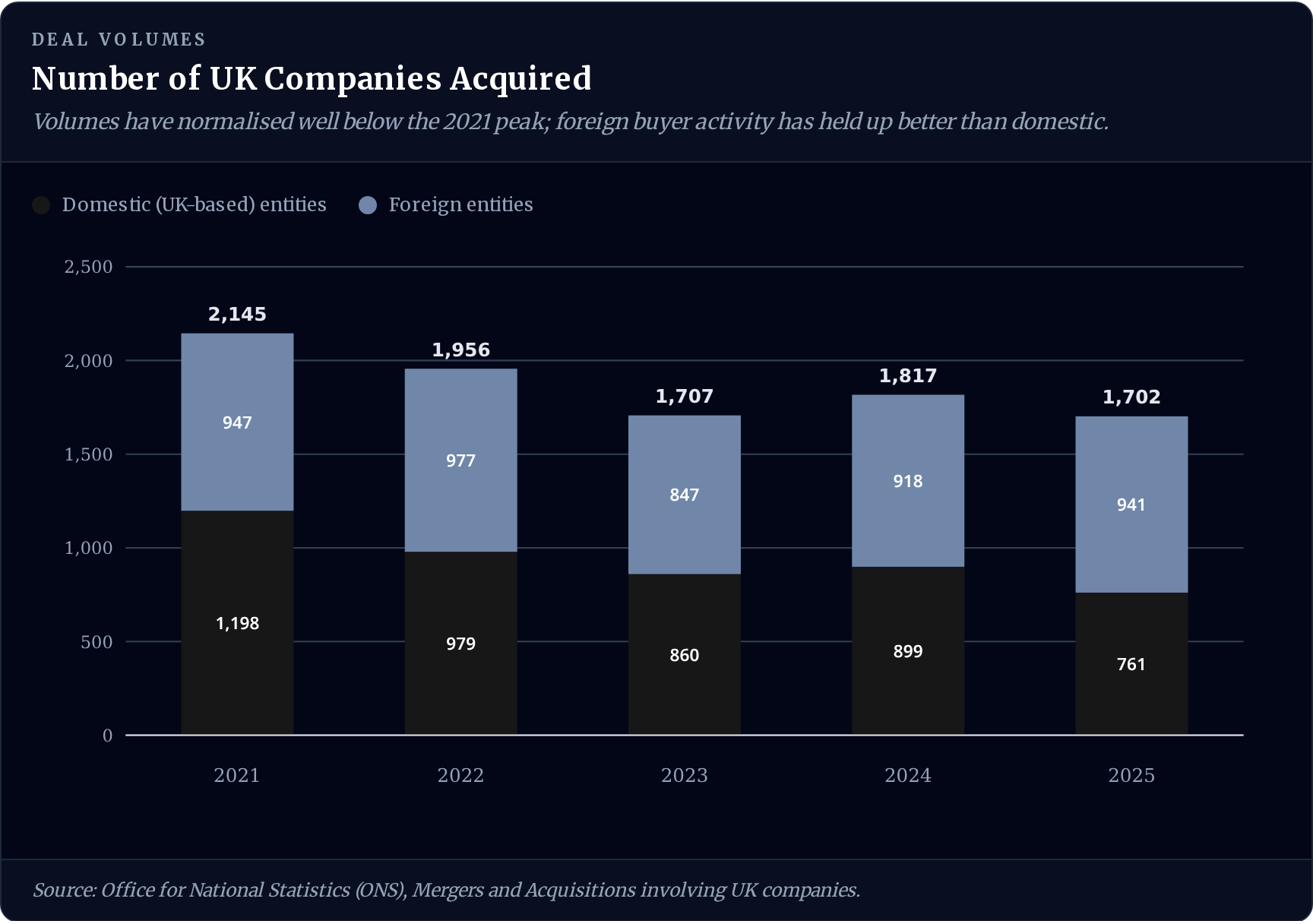
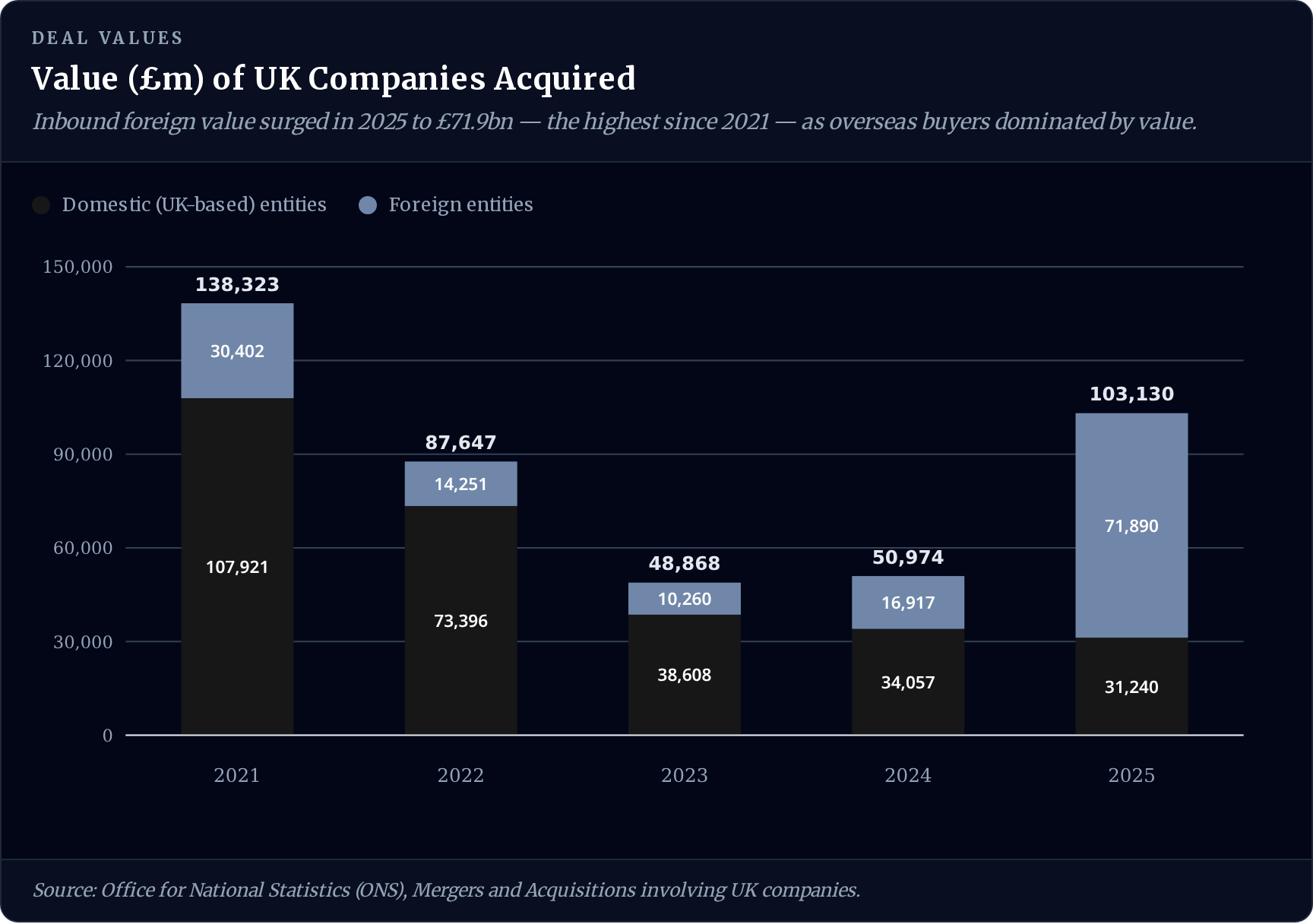
Foreign acquirers now dominate UK dealmaking by value. Across 2025 as a whole, overseas buyers accounted for the majority of total UK M&A value, and inbound value reached its highest quarterly level since 2021 in Q4. Overseas strategics and financial sponsors continue to be drawn by structural sterling weakness versus prior years, the depth of UK management talent, and the chance to acquire market-leading businesses at valuations that still screen as attractive in their home currencies.
For an owner, this is not just market colour — it is a lever. An overseas trade buyer, valuing your business in a stronger home currency and paying for UK market access, may put a materially higher figure on it than the obvious domestic acquirer. But those buyers only bid if a process reaches them. Most owners never see international interest, simply because they never ran a process built to attract it — and a bilateral conversation with the nearest domestic buyer quietly forecloses the premium.
Mapping the right international buyer universe is core to what we do. Have a confidential conversation →
What Does This Mean for a Business Like Mine?
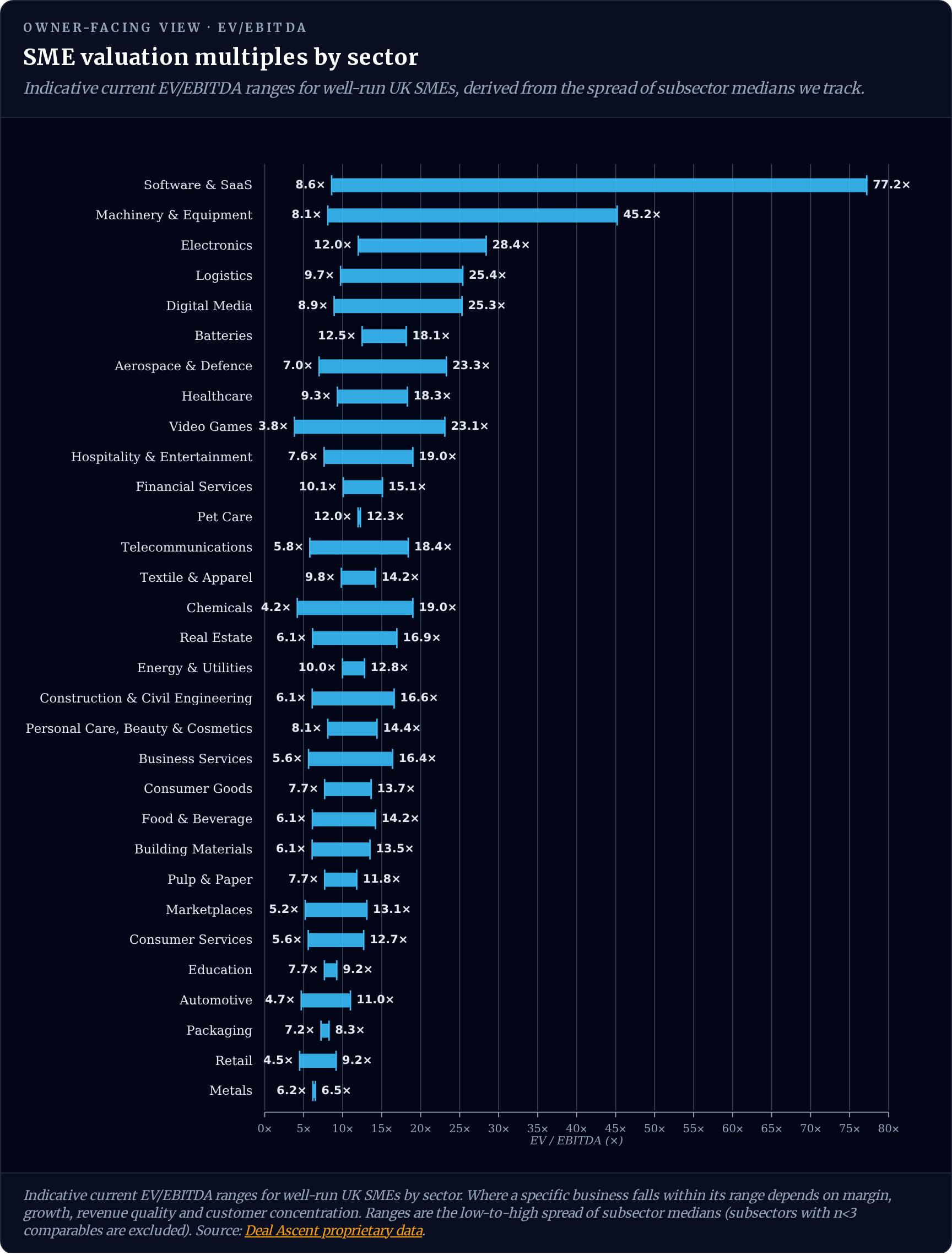
Aggregate deal values run to tens of billions, but the number most owners actually want is simpler: what is a business like mine worth? Below is where private-market EV/EBITDA multiples currently sit across the sectors we track — the typical range a well-run SME transacts within, before adjusting for its own margin, growth and quality.
These sector ranges are deliberately broad: each one spans several distinct subsectors, and the exact multiple for a specific business depends on its margin, growth, revenue quality and customer concentration. For a more detailed subsector-by-subsector view, see our valuation multiples page. At Deal Ascent, we maintain the broadest available database of UK SME sector multiples.
Wondering where your business sits within — or above — its sector range? Get an indicative valuation →
Macro and Geopolitics — Cuts Have Stalled
Monetary policy remains central to M&A sentiment, and the picture has shifted materially since late 2025. After peaking at 5.25% in 2023-24, the Bank of England cut Bank Rate through 2024 and into 2025, reaching 3.75% by mid-2025 — but it has since held there. The Monetary Policy Committee kept rates at 3.75% at its June 2026 meeting on a 7-2 vote, with two members pushing for a hike to 4%.
The reason for the pause is energy. The escalation in the Middle East, including conflict involving Iran, pushed oil and gas prices and shipping costs higher through the first half of 2026. UK CPI, which had been drifting back towards 2%, has hovered around 2.8%, above target, and the Bank has warned it could rise further as energy costs feed through. Markets that a year ago priced steady cuts now debate whether the next move is a cut or a hike.
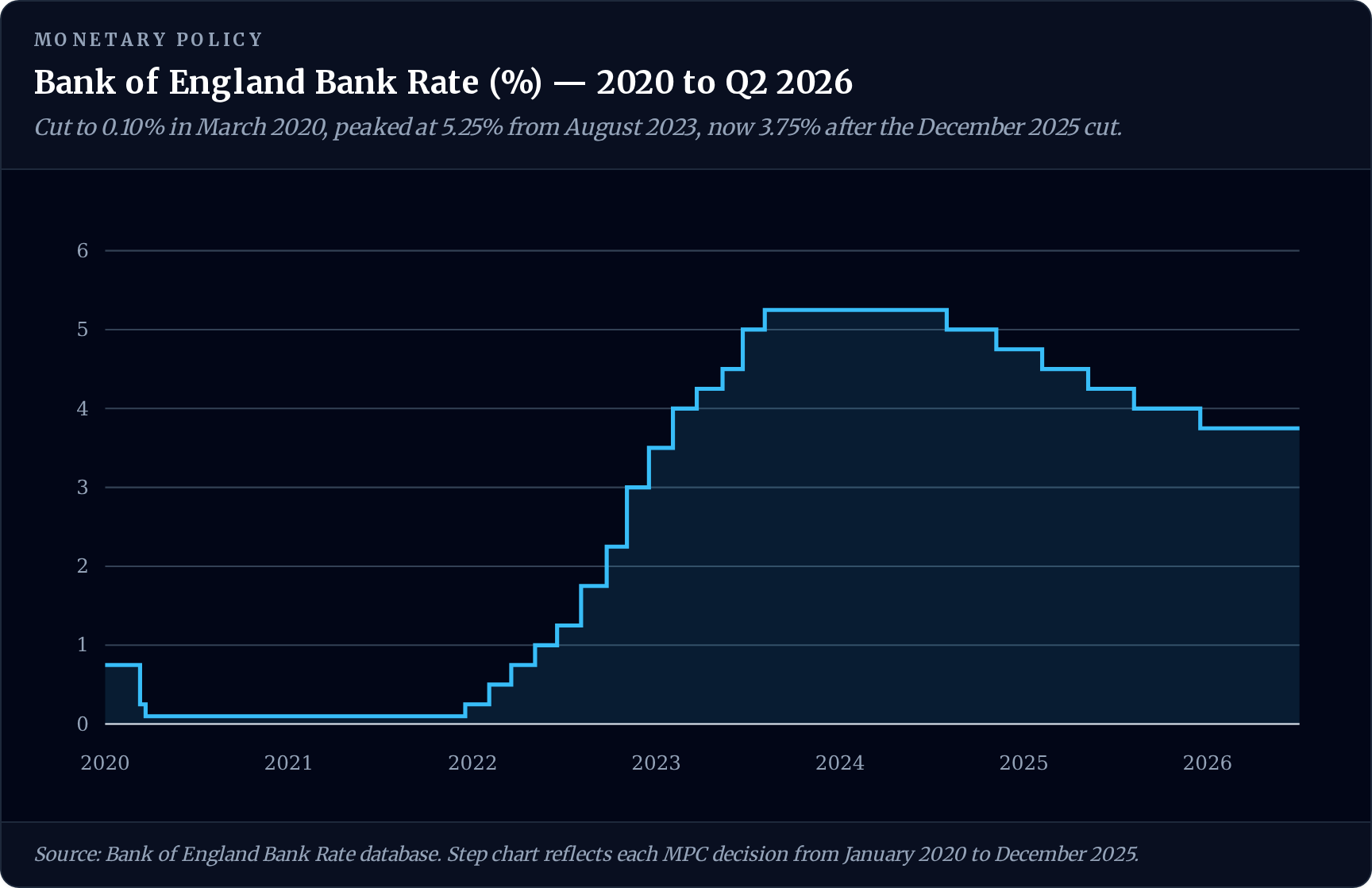
For dealmakers this cuts both ways. Real borrowing costs remain materially higher than in the 2010s, keeping financial buyers disciplined on leverage and widening the gap between buyer and seller price expectations. At the same time, the absence of a fresh shock — and the possibility that rates have found a floor rather than a ceiling — gives well-capitalised trade and financial buyers enough visibility to underwrite the right deals with conviction. Buyers are transacting; they are simply being far more selective about where.
For a seller, higher-for-longer rates have a concrete consequence: buyers are more disciplined on leverage and more focused on downside protection, which pushes deal structures away from clean all-cash-at-completion and towards earn-outs, deferred consideration and tighter warranties. A deal agreed today is more likely to carry contingent elements than the same deal would have in 2021 — which makes how the structure is negotiated, not just the headline price, central to what you actually bank.
Plenty of Capital — Record Dry Powder, Concentrated Deployment
For shareholders, the practical point is less "who" in the abstract and more how the equity story is framed for each buyer group — synergy-driven industrial logic on one side, roll-up and value-creation levers on the other — at a time when capital on the sidelines is at record levels. PitchBook estimates closed-end private capital funds globally held around $4.6 trillion of dry powder in 2025, with private equity accounting for the bulk of the growth, even as fundraising has slowed. That undeployed capital is increasingly concentrated in funds two-to-five years into their investment period, intensifying pressure to deploy and sharpening competition for genuinely high-quality assets.
Recent announced UK transactions across financial services, software, healthcare, industrials and specialist manufacturing illustrate the mix of strategic and financial buyers active in the market.
| Date | Target | Sector | Acquirer | Buyer Type | £bn |
|---|---|---|---|---|---|
| Jun 2026 | Schroders | Asset management | Nuveen (US) | Strategic / PE-backed | 9.9 |
| May 2026 | Beazley plc | Specialty insurance | Zurich (Switzerland) | Strategic | 8.1 |
| Mar 2026 | Pension Insurance Corp. | Insurance | Athora (Bermuda) | Institutional capital | 5.7 |
| Feb 2026 | Smiths Interconnect | Precision components | Molex / Koch (US) | Strategic | 1.3 |
| Jan 2026 | Senior plc | Aerospace / industrials | Undisclosed | Strategic | 1.0+ |
| Dec 2025 | Spectris plc | Precision instruments | KKR (US) | Private equity | 4.7 |
| Oct 2025 | Verona Pharma plc | Healthcare / biotech | Merck & Co (US) | Strategic | 7.4 |
| Jul 2025 | Reckitt's Essential Home | Home care | Advent (US) | Private equity | 3.6 |
| Jul 2025 | Direct Line plc | Insurance | Aviva plc (UK) | Strategic | 3.7 |
| May 2025 | Deliveroo plc | Food delivery tech | DoorDash (US) | Strategic | 2.9 |
| Jan 2025 | DS Smith | Packaging | International Paper (US) | Strategic | 5.8 |
Selected announced or completed UK transactions, 2025–H1 2026. Values are approximate headline figures.
A Selective, Quality-First Market
If there is one defining characteristic of the current SME deal environment, it is selectivity. Several themes stand out:
- Evidence over narrative: Buyers are insisting on evidence, not just story: KPIs around recurring revenue, customer concentration, churn, margin resilience and cash generation.
- Due diligence: Increased scrutiny on technology, compliance, ESG, cybersecurity, management depth, and resilience to economic cycles and geopolitical shocks — with timetables lengthening as a result.
- Valuations: Cyclical or weak performers face multiple compression or struggle to transact at all, while businesses combining growth with strong margins continue to command premium multiples.
- Structure: Earn-outs, vendor loan notes and other structured mechanisms are being used more frequently to bridge valuation gaps and share risk, particularly where earnings are volatile or heavily adjusted.
For sellers, this means preparation and positioning are no longer optional. The businesses that win competitive tension are those that can present clean numbers, a credible growth story and a clear role for the acquirer.
Sector Pockets of Strength
Listed sector performance over the last twelve months tells a story of sharp divergence rather than a broad rising tide. "Technology" is not one trade but several: semiconductors have been the standout, up more than 130% on a rebased view and pulling well clear of everything else, yet software sits at the very bottom of the pack, trading below where it started the year. The gap between the two is a caution against treating any sector as a single bet.
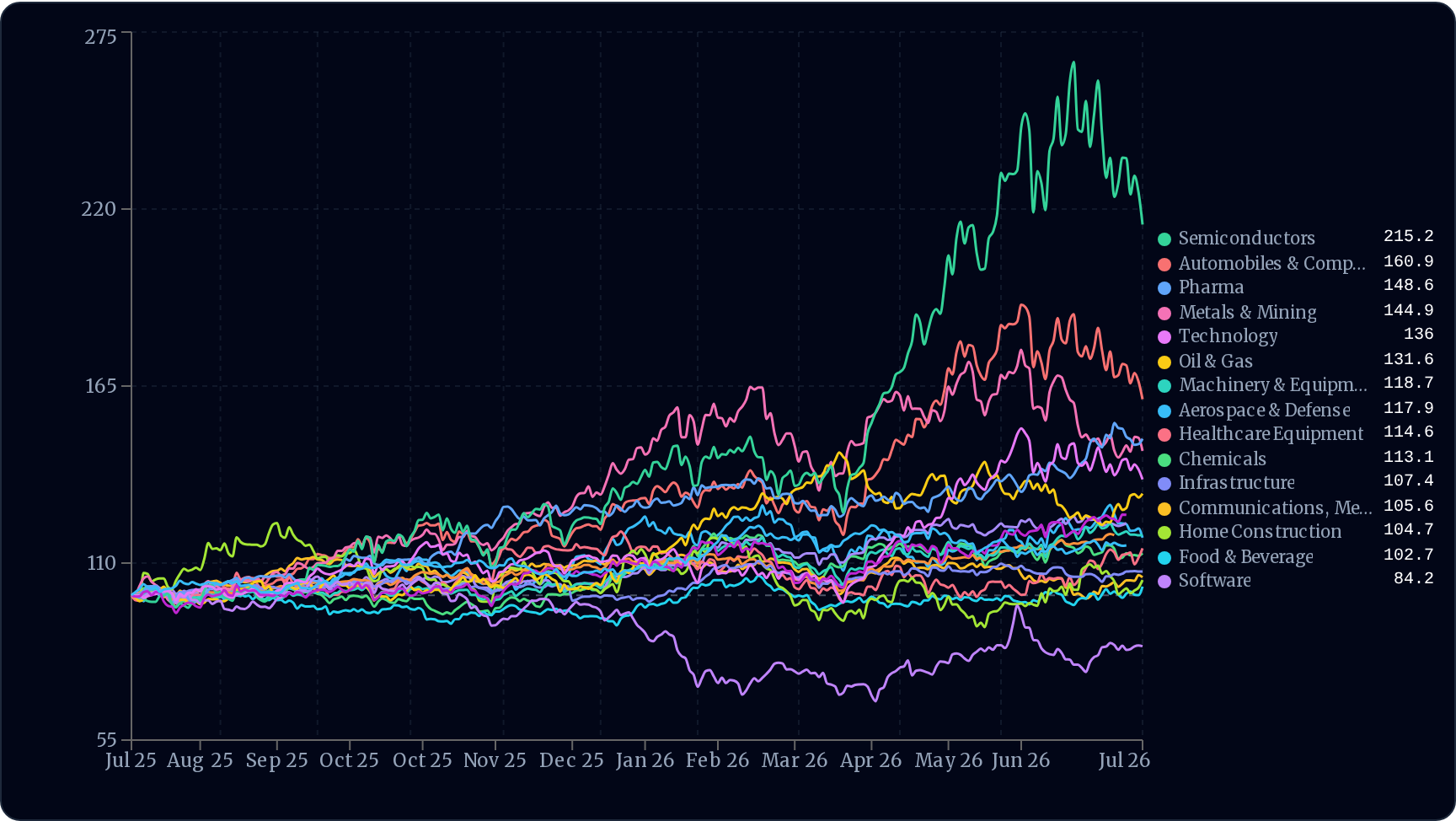
Live sector ETF performance, rebased to 100 over the trailing 12 months. Explore the full 1Y / 2Y / 3Y interactive chart on our Sector Stock Market Indices page.
Behind the semiconductor leaders, automobiles and components form a clear second tier, followed by pharma and the broader technology complex. A dense middle group — oil and gas, transportation, aerospace and defence, engineering and construction, utilities and chemicals — has delivered solid but more measured gains of roughly 10-25%. Food and beverage, communications and healthcare equipment have largely tracked sideways, while home construction and software have lagged outright.
For dealmakers the read-through is about quality and positioning rather than sector labels. The market is rewarding businesses with genuine pricing power, structural demand and tangible earnings — the characteristics underpinning the semiconductor, defence and industrials names near the top — far more consistently than it is rewarding the sector as a whole. Cyclical or capital-hungry models, and anything perceived as commoditised, have found the environment tougher. That selectivity in public markets mirrors exactly what SME sellers are seeing in private processes.
What This Means for SME Owners
For UK SME shareholders, the message in the second half of 2026 is nuanced but still constructive. The market is not racing back to the froth of 2021–22, deal volumes have cooled, and significant macro and geopolitical uncertainty remains — but conditions are genuinely supportive for well-prepared sellers of quality businesses. Several practical implications follow.
This is written with founder- and family-owned businesses in mind — typically those valued between around £5m and £50m, where a well-run process and the right buyer universe make the greatest difference to the outcome.
1. Timing
For many owners, the next 12–24 months are a sensible window to prepare and, where appropriate, test the market while valuations for high-quality assets remain robust and buyer appetite is supported by record pools of undeployed capital — even against a backdrop of ongoing uncertainty and softer headline volumes.
2. Preparation
Value is being won or lost long before you "go to market." With buyers running deeper, longer diligence, robust management information, a clear growth plan and early diligence on contracts, IP, tax and HR can materially improve outcomes.
3. Flexibility
Being open to partial exits, staged deals or creative structures can widen the buyer universe and help bridge the wider expectation gaps that higher financing costs have created.
4. Positioning
Tailoring the equity story to the likely buyer universe — trade versus PE, domestic versus inbound — is essential in a selective, increasingly foreign-led market. With overseas buyers driving the majority of UK deal value, understanding how an international acquirer will view the asset is now a core part of preparation, not an afterthought.
From our perspective at Deal Ascent, the most successful M&A transactions in this environment are those where shareholders invest time up front: clarifying objectives, understanding buyer dynamics and preparing the business to stand up to a far more sophisticated level of scrutiny.
None of this argues that every owner should move now. It argues for clarity on the trade-off. Moving into the current market means meeting genuine buyer appetite and record levels of undeployed capital, with quality assets in short supply. Waiting risks the window narrowing if rates, geopolitics or sentiment turn — and it forecloses the multi-year preparation that most improves an outcome. The point is not to rush; it is to decide deliberately, with a clear view of where your business and your sector actually stand.
If you are weighing that decision, a short, confidential conversation — with no obligation — is the best place to start. Talk to Deal Ascent →