What Is My Business Worth? Valuation Drivers & Net Proceeds

What a business seller banks depends on how comparable listed peers are trading, how recent M&A transactions have been priced, where the sale sits in the cycle, the quality of the storytelling and disclosures, how hard the buyer competition is pushed, how the Sale & Purchase Agreement bridges enterprise to equity value, and any pre-sale tax structuring to mitigate Capital Gains Tax. Underneath it all, the business's own fundamentals — margin, growth, quality — anchor the multiple.
Ask most owners what their business is worth and they reach for a multiple: "we should get eight or nine times EBITDA." It is a reasonable starting point, and for a well-run business it is often roughly right. But a multiple is not plucked from the air — it is anchored to where listed peers are currently trading and how recent deals in the sector have been priced. Where the public markets sit in their cycle, and how the sector's fundamentals are being judged at that moment, can move that anchor point materially. The same business can command a fuller or thinner multiple depending on nothing it has done itself, but on the weather in the market around it.
This article sets out how a UK business is valued and, just as importantly, what an owner actually keeps: how the headline price is established, how that becomes equity value in the contract, and how much of that equity value survives as take-home proceeds after tax. Understanding all three — and preparing for them early — is what separates a good outcome from an ordinary one.
Key takeaways
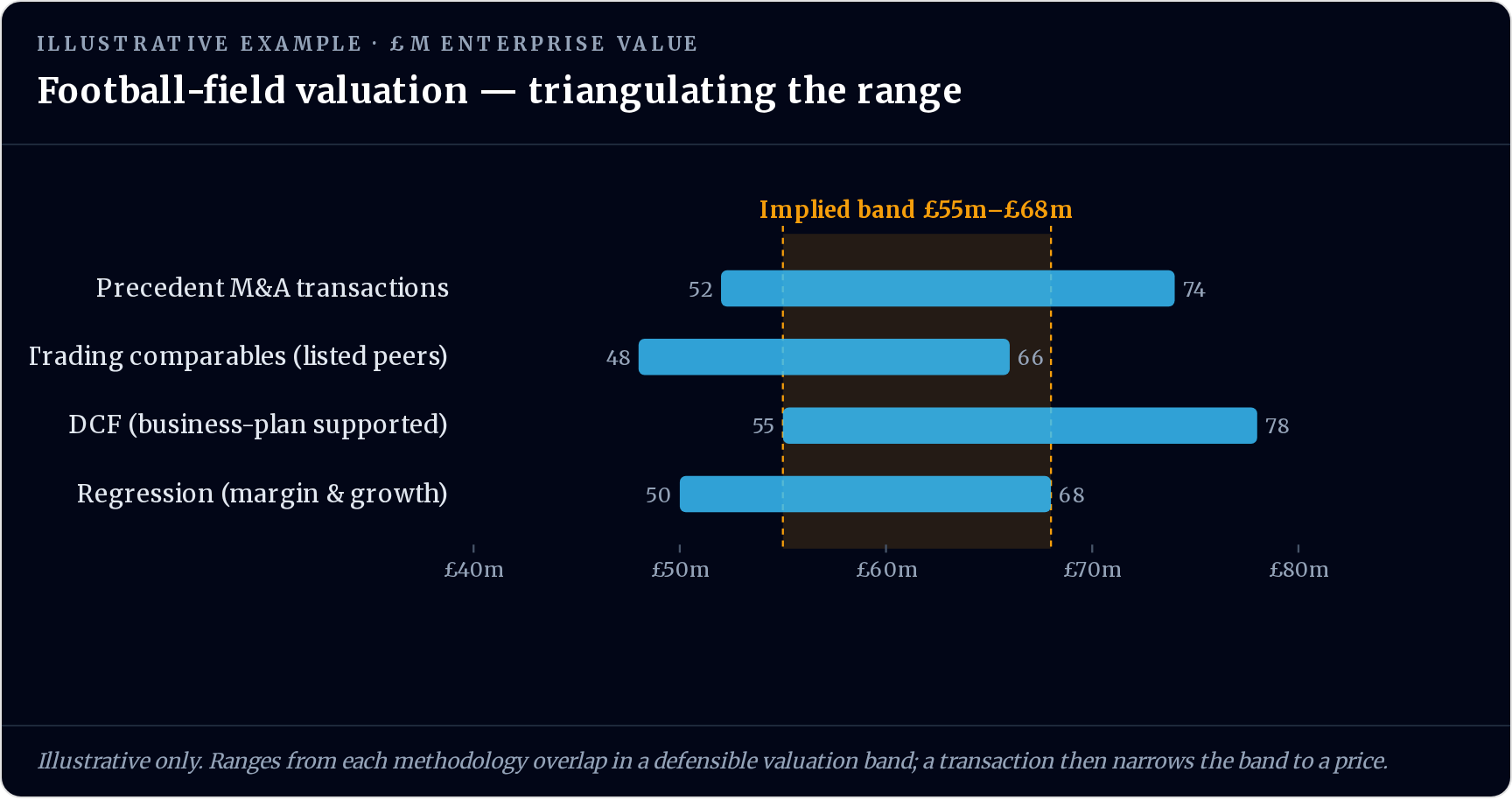
- A business is conceptually valued by triangulating three methodologies — trading comparables, precedent M&A transactions and a discounted cash flow. A transaction then shifts the value from concept to actual price.
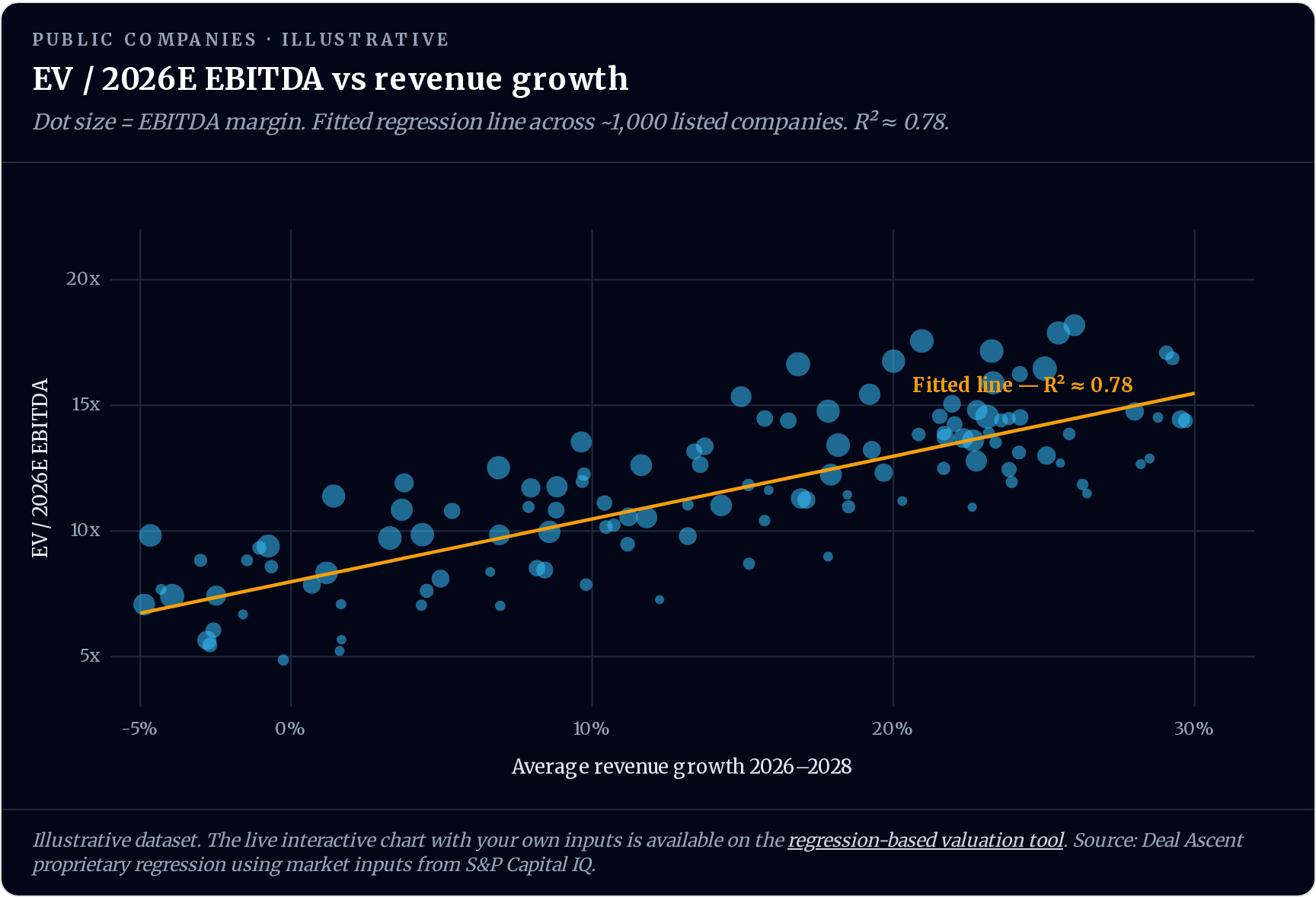
- Within a sector, margin and growth drive most of the EV/EBITDA multiple: our regression across ~1,000 listed companies puts it at roughly 78% (R² ≈ 0.78).
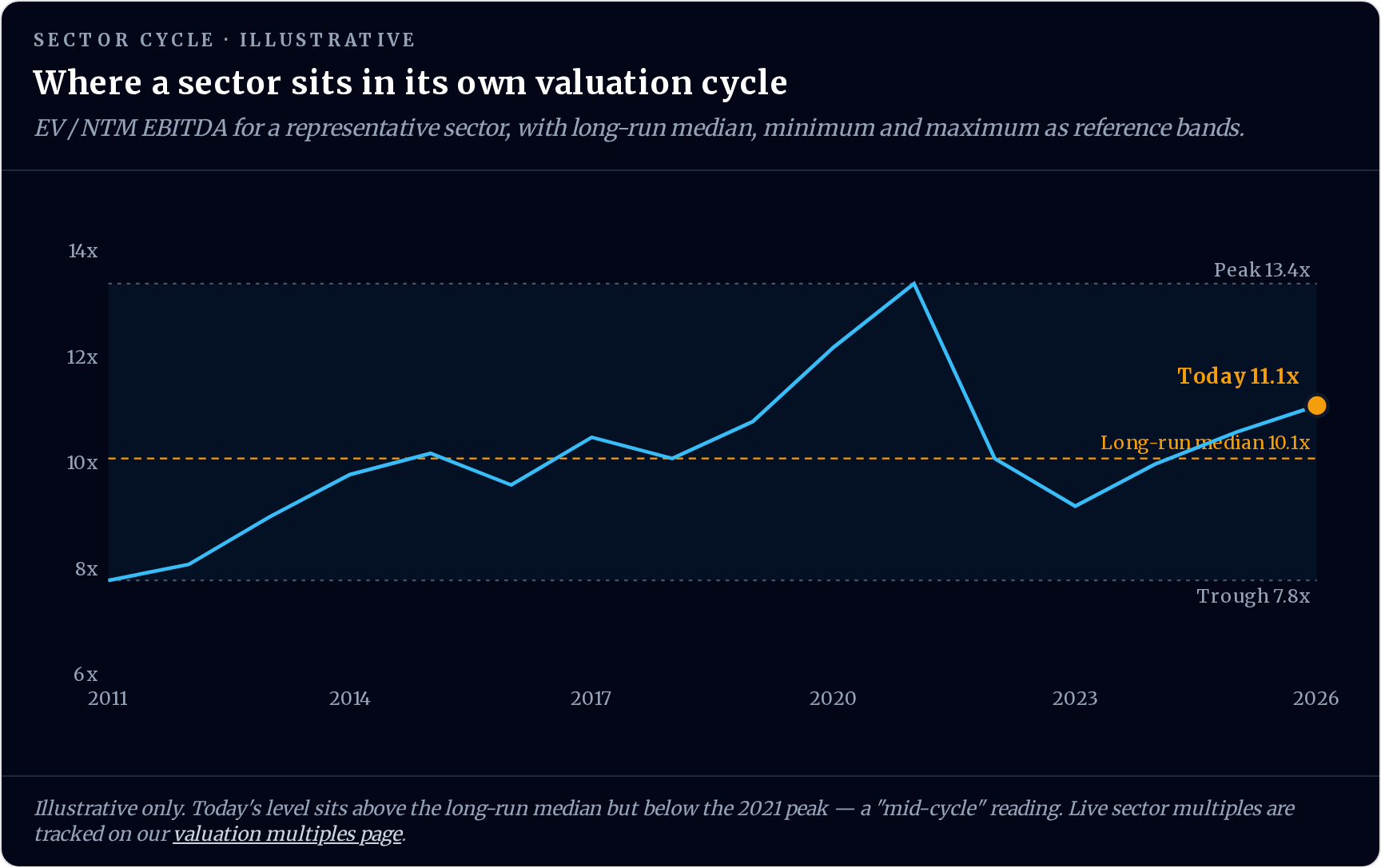
- Timing matters: where a sector sits in its own valuation cycle can move the multiple before any negotiation begins.
- The headline enterprise value is not what you bank. The SPA's enterprise-to-equity bridge, the closing mechanism (locked box vs completion accounts) and warranties determine equity value.
- Take-home proceeds depend on pre-sale tax structuring — including CGT and Business Asset Disposal Relief — which must be planned months ahead of a sale.
Stage one: how the headline price is established
The headline price is not a single calculation but the product of four things working together — the valuation benchmarks a business is measured against, the story that frames it, the information a buyer is given to price, and the process that puts buyers in competition. Each is a lever, and each is where preparation pays.
The three valuation methodologies: comparables, precedents and DCF
Three reference points frame almost every valuation. The first two are market-based. Where listed peers are trading sets the gravitational field for private multiples, which is why the point in the cycle matters so much. And how recent M&A transactions have been priced — precedent deals in the sector — tells buyers and sellers what the market has actually been willing to pay, not just what it quotes. The third is intrinsic rather than market-based: the discounted cash flow implied by the business plan — the value the forecast would support if a buyer believes it. A credible, well-evidenced plan pushes the DCF — and the price conversation — upward; a thin one drags it down.
No single one of these gives "the answer". Deriving a valuation is more an art than a science: each methodology produces a range, and the judgement lies in triangulating between them — understanding why the DCF sits above the trading comparables, or why precedent deals command a premium to today's public multiples — to arrive at a defensible view.
Timing: where your sector sits in the valuation cycle
Because those benchmarks move, timing is one of the most under-appreciated drivers of value — not the owner's readiness, but the market's. Every sector trades in cycles, and at any given moment a vertical is somewhere between its historical trough and its historical peak, quite independently of how good any individual business within it is.
A business can be performing superbly while its sector is being valued cautiously, and a mediocre business can command a full price simply because its sector is in favour. Selling a strong business into a weak sector cycle, or a fair business into a strong one, changes the multiple before any negotiation has begun. This is why we track listed sector multiples continuously: current trading levels relative to a sector's own long-run average, trough and peak tell an owner whether the window is open.
See where your sector's multiples sit today vs their historical range →
Timing is not about calling the top. It is about knowing where your sector sits in its own cycle before you decide whether to move.
What drives your EBITDA multiple: margin and growth
Benchmarks and cycle set the field; where a business lands within it comes down to its own fundamentals. The two levers that move a multiple most are margin and growth. This is widely asserted and rarely evidenced. We have quantified it.
Our proprietary regression model fits EV/EBITDA multiples against forecast growth and margin across a universe of around 1,000 listed companies. Margin and growth alone explain roughly 78% of the variation in multiples (R² ≈ 0.78). Most of why one business trades at fifteen times and another at seven is captured by just two variables — how profitable it is, and how fast it is growing.
A business with a 25%+ EBITDA margin and consistent double-digit growth sits, predictably, near the top of its sector's range. A business with thin margins and flat revenue sits near the bottom, however strong its brand or history. And because the relationship is statistical rather than anecdotal, it also tells an owner which improvements will move their number most before a sale — and by roughly how much.
The other quality factors — recurring revenue, customer concentration, and reliance on the owner — then explain much of the remaining dispersion. Contracted, repeat revenue is worth more than project income a buyer cannot count on. A single client at 40% of sales is a discount every buyer will price in. And a business that runs without its owner is worth more than one that is its owner.
Explore our regression-based valuation model →
Positioning the equity story for buyers
If the regression tells you where a business sits on the numbers, positioning determines whether it is valued at the top or the bottom of the range those numbers justify. The same set of accounts can support very different narratives, and buyers pay for the narrative as much as the numbers. This is where storytelling anchors the business plan — the credible growth case that lifts the DCF and justifies the top of the range.
A trade acquirer is buying synergy, market access and strategic fit; a private-equity buyer is buying a platform, a management team and a value-creation plan. The same business must be presented differently to each, foregrounding the aspects that matter to that buyer's model. Done well, positioning is what lifts a business from the median of its sector to the upper quartile — not by changing the facts, but by making the right facts legible to the right buyer.
Two businesses with the same accounts can sell a full turn apart on the strength of the story alone.
How to draft an Information Memorandum and teaser →
Due diligence and the disclosure package
A buyer prices what it is shown. The information package an owner presents — the quality of the numbers, the clarity of the growth story, the issues surfaced and resolved in advance — determines what a buyer is willing to pay, and how confidently. The fastest way to lose value later is a bad surprise in diligence: the moment a buyer uncovers something undisclosed — a customer contract with a change-of-control clause, an unresolved tax position, a key employee with no tie-in, an overstated adjustment — they have both a reason and the leverage to reprice.
A well-prepared process anticipates this. Running diligence on your own business before the buyer does — assembling a clean data room, surfacing and resolving issues on contracts, IP, property, employment and tax — means presenting problems on the seller's terms rather than having them discovered on the buyer's. A well-organised data room typically spans the following high-level workstreams:
| Workstream | Indicative contents |
|---|---|
| Corporate | Structure chart, statutory books, shareholder agreements, cap table |
| Financial | Audited accounts, management accounts, budgets, KPI pack |
| Commercial | Customer and supplier contracts, pipeline, concentration analysis |
| Legal | Material contracts, litigation, regulatory, insurance |
| People / HR | Org chart, key employment terms, incentive schemes, pensions |
| IP & IT | Registered IP, licences, systems, cyber and data protection |
| Property | Leases, freeholds, dilapidations |
| Tax | Returns, correspondence, open positions, VAT |
Indicative top-level index only; a full working index runs to several hundred line items.
Every surprise in week ten is a discount. Every issue surfaced in week one is just a fact.
The competitive sale process: how tension moves price
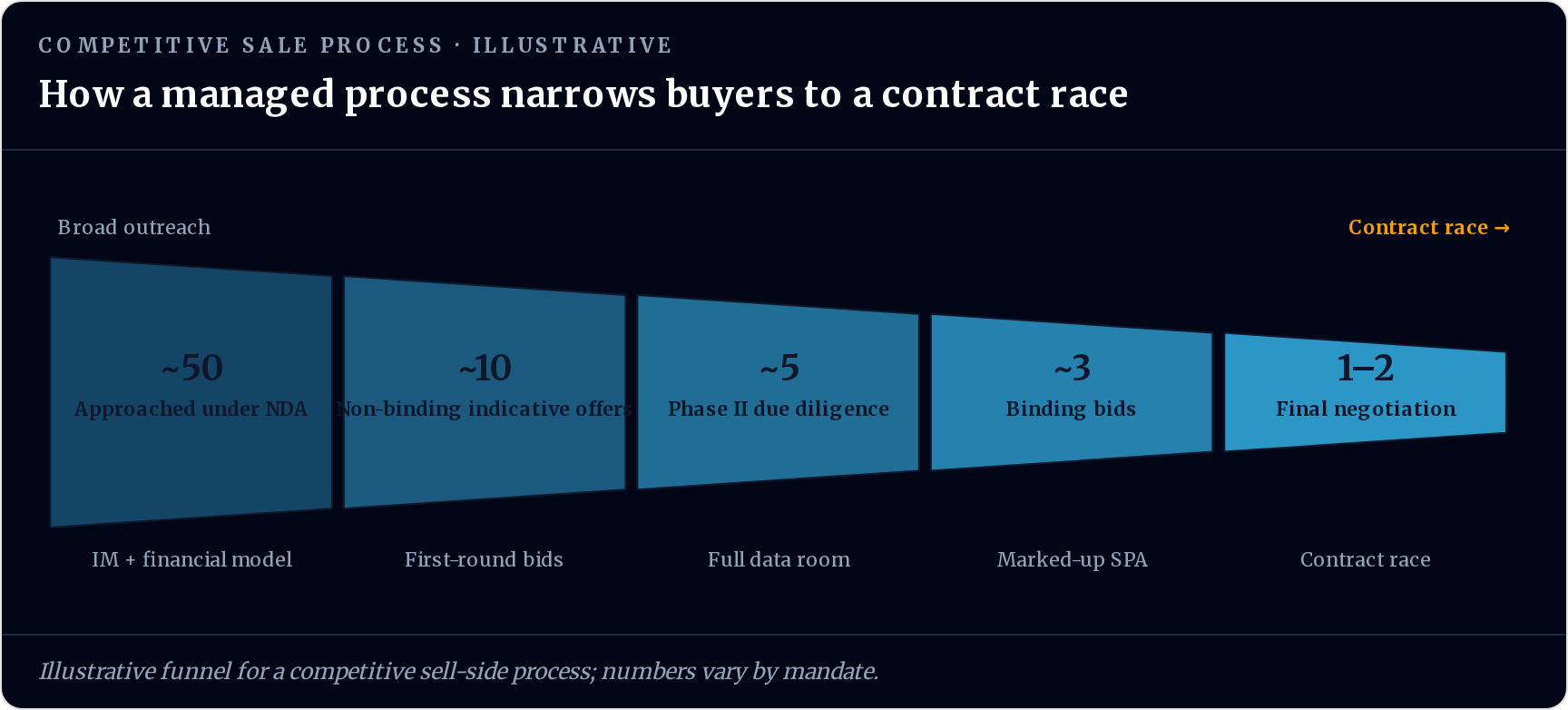
A valuation is a number on a page until two or more credible buyers want the same asset. Competitive tension — running a properly managed process with several potential acquirers advancing in parallel — is the single most powerful mechanism an adviser brings to bear on price.
A bilateral conversation with one buyer is a negotiation the seller usually loses slowly: the buyer sets the pace, controls the timetable, and knows there is no alternative. A managed process inverts that. When several buyers are working to the same deadline, each aware that others are at the table, the dynamic shifts decisively towards the seller. Price rises, terms improve, and — critically — the pace quickens.
That tension is most valuable at the end. A well-run process can engineer a genuine contract race, in which two or more buyers are taken into final documentation simultaneously, competing not just on price but on speed and certainty of completion. It is in that closing phase — when a buyer knows another party is a signature away — that the last increment of value, and the cleanest terms, are secured.
Stage two: from headline price to equity value
When the headline price is "agreed", the real negotiation begins. The Sale and Purchase Agreement is where enterprise value becomes equity value — the amount shareholders actually receive — and where significant sums move on points an unadvised seller may not even see.
The enterprise-to-equity bridge is the first of these: the adjustments for net debt, cash, and a normalised level of working capital that convert the headline figure into what shareholders actually receive. How working capital is defined and pegged, how debt-like items are treated — each is negotiable, and each moves the final number. The illustration below takes the same £60m headline enterprise value and shows two outcomes: one where the seller concedes ground on each line, and one where the bridge is tightly negotiated.
| Enterprise → equity bridge (illustrative, £m) | Poorly structured | Well structured |
|---|---|---|
| Headline enterprise value | 60.0 | 60.0 |
| Less: net debt | (8.0) | (8.0) |
| Working-capital adjustment vs peg | (2.5) | (0.3) |
| Debt-like items (leases, deferred consideration) | (1.8) | (0.6) |
| Leakage (pre-completion dividends, transaction costs) | (1.5) | (0.4) |
| Deferred / escrow held back at completion | (6.0) | (2.0) |
| Equity value received at completion | 40.2 | 48.7 |
Same £60m headline; an ~£8.5m difference in cash at completion — on structuring, not price. Illustrative figures only.
The closing mechanism then determines how and when that bridge is struck. Under a locked-box structure, the price is fixed to a historical balance sheet date and the seller keeps the economic benefit from that date to completion — giving certainty of proceeds and removing the post-completion adjustment. Under completion accounts, the final figure is calculated after closing against actual net debt and working capital — more accurate to the day, but leaving the number open to adjustment, and dispute, after the deal is done.
| Locked box | Completion accounts | |
|---|---|---|
| Price set | At a historical "locked-box" date | At completion, calculated afterwards |
| Certainty of proceeds | High — fixed at signing | Lower — adjusted post-completion |
| Post-completion adjustment | None | Yes — true-up against actuals |
| Economic risk / benefit to completion | Seller (via locked-box date) | Buyer (until completion) |
| Dispute risk | Low | Higher — over the completion accounts |
| Typically favours | Seller; clean, well-prepared targets | Buyer; where accounts are volatile |
Then come the protections a buyer will seek and a seller must contain: representations and warranties and the associated liability, the indemnities for identified risks, and the structuring of any earn-out — how much consideration is deferred, on what metrics, over what period, and with what protections for a seller who no longer controls the business. A poorly constructed earn-out is where a seemingly full price quietly erodes; a well-constructed one aligns both sides and protects the seller's upside.
Stage three: take-home proceeds, tax and CGT structuring
The number that matters is not enterprise value, nor even equity value. It is net, banked, after-tax proceeds — and what happens to the portion still at risk after completion. This last bridge is governed by two things: the tax structure in place before the deal, and how the post-completion tail is managed.
The first is managing the tail: the deferred consideration, the escrow retentions, the warranty exposure that can claw back value for months or years after the deal completes. A headline price with 30% deferred and a wide warranty cap is not the same as its equivalent in cash at completion, and treating the two as equal is one of the most common and expensive errors an owner makes.
The second is tax — and this is where thinking ahead matters most. The relief owners have historically relied on has been sharply curtailed: from 6 April 2026, Business Asset Disposal Relief is worth a maximum of around £60,000 per person, a fraction of its former value. That makes proactive structuring more consequential than at any point in recent memory.
Our detailed guide to pre-sale tax planning for UK business owners sets out the main structures, qualifying periods, HMRC clearances and implementation timetable.
Vehicles such as family investment companies, family trusts and pension structures can play a significant role in managing inheritance tax, succession and the long-term compounding of proceeds — but they are succession and wealth-planning tools, not switches that eliminate capital gains tax on a sale. Crucially, they take time. Establishing these structures properly can require months of lead time, HMRC has an interest in how they are set up, and transferring assets in can itself be a taxable event if done carelessly. Several only deliver their intended benefit if they are in place well before a transaction — often with minimum holding periods measured in months before a sale — which means the planning has to begin before the business is anywhere near the market.
The tax structure that protects your proceeds has to be built before the sale starts — not negotiated during it.
Business Asset Disposal Relief: qualifying conditions and planning →
Valuing a business: bringing it together
Three bridges separate a headline multiple from money in the bank. The first — benchmarks, positioning, disclosure and process — establishes the headline price. The second — the SPA, the enterprise-to-equity bridge, and the closing mechanics — converts it into equity value. The third — tax structuring and management of the tail — determines how much of that survives as take-home proceeds.
Each stage is a place where value is won or defended, and almost none of it is visible in a headline valuation. Crucially, the earliest decisions — how the business is positioned, when it goes to market, and above all how the proceeds are structured for tax — are also the ones that close first. By the time an owner has a buyer at the table, many of the most valuable levers have already gone.
Considering a sale, a partial exit, or bringing in a partner? The earlier the conversation starts, the more of these levers remain open. We're happy to talk it through in confidence, with no obligation.
Start a conversation → · Get an indicative valuation →
Frequently asked questions
Is my business worth the headline EBITDA multiple?
The multiple gives an enterprise value, which is the starting point of a negotiation, not the amount shareholders receive. Net proceeds depend on the enterprise-to-equity bridge (net debt, cash and working capital), the closing mechanism (locked box or completion accounts), the structure of any deferred or contingent consideration, warranty and indemnity exposure, and the tax structure in place before the sale.
Does timing affect how much my business sells for?
Significantly. Every sector trades in cycles, and current multiples sit somewhere between the sector's historical trough and peak independently of any single business's quality. Selling into a strong sector cycle, or waiting out a weak one, can change the multiple before negotiation begins.
What has the biggest effect on my valuation multiple?
Within a sector, margin and growth dominate. Our regression across around 1,000 listed companies finds these two factors explain roughly 78% of the variation in EV/EBITDA multiples. Recurring revenue, customer concentration and reliance on the owner explain much of the rest.
How does a competitive sale process increase the price?
Running several credible buyers in parallel — rather than negotiating with one — shifts leverage to the seller. A well-managed process can create a contract race in which buyers compete on price, terms and certainty of completion, securing the final increment of value and the cleanest terms in the closing stage.
Should I plan my tax structuring before selling my business?
Yes, and early. From 6 April 2026, Business Asset Disposal Relief is worth a maximum of around £60,000 per person, making proactive planning more important than before. Structures such as family investment companies and family trusts are succession and wealth-planning tools rather than ways to eliminate CGT on a sale, and several require months of lead time and must be in place well before a transaction to deliver their intended benefit.
Note: tax figures reflect rules as at mid-2026 (BADR £60k cap from 6 April 2026). Tax treatment depends on individual circumstances and changes; this article is intended for information purposes only and does not constitute financial, tax or legal advice.