What to Do When a Buyer Knocks on Your Door to Acquire Your Business

You are about to negotiate the biggest sale of your life with no leverage at all. That single decision could cost you a quarter of what your business is actually worth.
An unsolicited approach from a trade buyer or a private equity sponsor is one of the more flattering moments in a business owner's career. Someone has done their homework, identified your business as a target, and picked up the phone. It is tempting to take the conversation at face value and negotiate directly. Doing so, however, is closer to playing poker with your cards face up: the buyer reads your position clearly, while you have no competitive tension or alternative bidder pushing them to raise their offer.
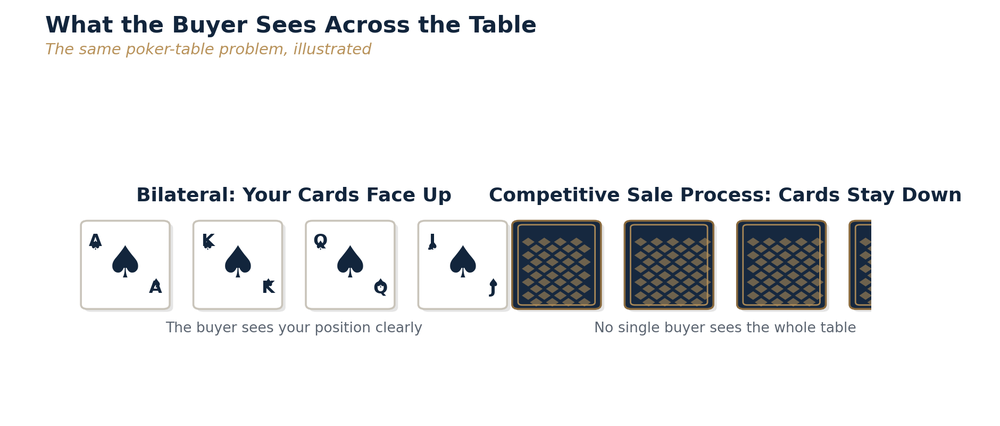
The flattery trap
Buyers rarely approach mid-market owners directly by accident. A private, bilateral conversation with no other buyer at the table lets a strategic acquirer or a private equity sponsor set the pace, control the flow of information and, most usefully for them, avoid the competitive sale process that pushes price toward true market value. An auction with several credible bidders produces a materially different outcome than a single conversation behind closed doors, because scarcity and comparison do the negotiating work.
This article calls the two paths by name. A bilateral process involves one seller, one buyer, and no one else in the room. A competitive sale process replaces that with a curated, competitive field. Seeking a bilateral dialogue is a rational, low-cost way for a buyer to source a deal. It becomes a problem for the seller only when genuine interest is mistaken for a fair price.
The pitfalls of accepting the first valuation
Whoever names a figure first hands the other side useful information. Quote too low, and you set a ceiling before due diligence — the buyer's detailed check of the business's finances, contracts and operations — has even started. Quote too high without support, and you risk losing credibility before negotiation is properly under way. Either way, once a number is on the table, the conversation anchors to it.
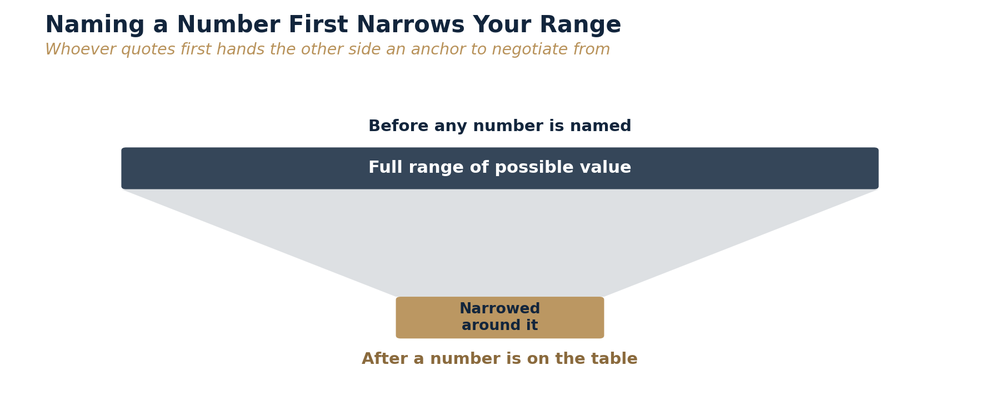
A second cost exists that has nothing to do with price: operational distraction. Negotiating directly with a buyer, taking their calls, drafting responses and second-guessing your own numbers distracts from running the business. Performance dips are common in unadvised negotiations, and a sharp buyer's team will spot them. A Quality of Earnings review routinely surfaces normalised working-capital adjustments or triggers a locked-box mechanism that fixes the price at an earlier date and compensates the buyer for any leakage since. Each mechanism gives the buyer a technically defensible route to chip the price down when you have the least leverage left to resist.
A buyer who initiates contact usually expects to ask the first question, not answer it. Reversing that expectation is critical: invite the buyer to set out their indicative view of value and rationale before discussing any figure of your own.
Why absence of competition eliminates leverage
The risk in a bilateral process is not only a lower price. It is what happens to the buyer's incentives once competition disappears.
A typical exclusivity period — the window after signing a preliminary agreement during which the seller agrees not to talk to any other buyer — runs eight to twelve weeks. From the moment it is signed, a seller's ability to walk away effectively disappears while the buyer's diligence team gets to work. Due diligence in a bilateral deal typically takes 1.5 to 2.5 times longer than in a competitive sale process because no competing timetable forces the buyer to move at pace. That extra time carries a heavy cost: more than 90% of live bilateral deals pick up price erosion or late-stage purchase price adjustments before completion. Extended, adversarial diligence is also why more than half of bilateral M&A negotiations collapse outright.
Figures reflect Deal Ascent's transaction experience and observed patterns across bilateral, unadvised negotiations. Outcomes vary by sector, deal size and process quality.
The polite pivot
None of this means the approach should be rejected outright. Maintaining a courteous dialogue is essential: buyers remember how a process is handled, and a poorly managed rejection closes doors that might prove useful later. The purpose of a reply is to preserve goodwill while introducing professional representation between owner and buyer.
The polite pivot, in practice "Thank you for the interest; it is genuinely appreciated. Any conversation regarding the business's future will run through our advisers, alongside other relevant parties. We would be glad to include you on that basis."
The core message is simple: you are welcome to participate on equal terms with every other prospective buyer.
Create a controlled sale process
The real opportunity in an unsolicited approach is to use it as the catalyst for a competitive sale process. Rather than a broad, public market sale, this means quietly inviting a curated shortlist of credible buyers, both strategic and financial, so that the initial enquiry becomes one bid among several rather than the only offer.
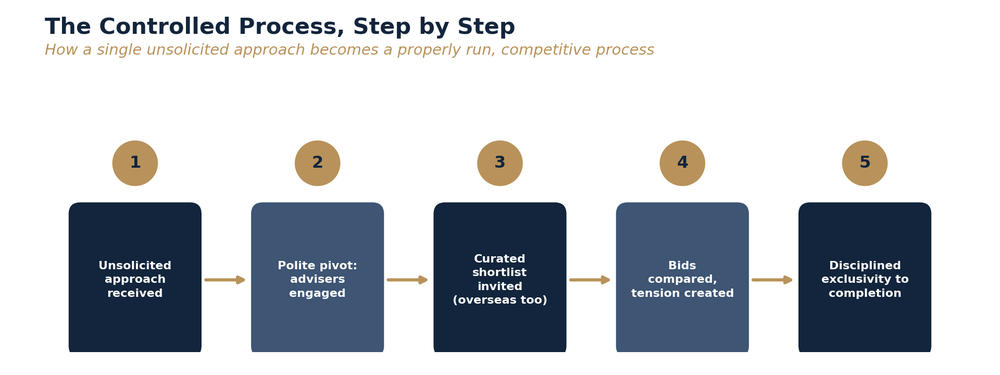
Process discipline matters just as much once a preferred bidder emerges. A shorter exclusivity window — four to six weeks rather than eight to twelve — maintains momentum and limits how long any single buyer can sit on a deal without competitive pressure. Some processes require buyers to reconfirm headline prices in writing at set intervals during diligence, with any downward move ending exclusivity and enabling re-engagement with other bidders. The principle remains constant: keep a genuine alternative alive, because alternatives, not paperwork, keep buyers disciplined.
Bilateral versus competitive sale process
The table below sets out what actually changes between the two approaches, across the dimensions that matter most to an owner.
Optionality and price discovery
A controlled process does more than lift the headline number. Having multiple credible offers grants an owner optionality: the ability to weigh price against completion certainty, payment terms, rollover equity and post-acquisition operational plans.
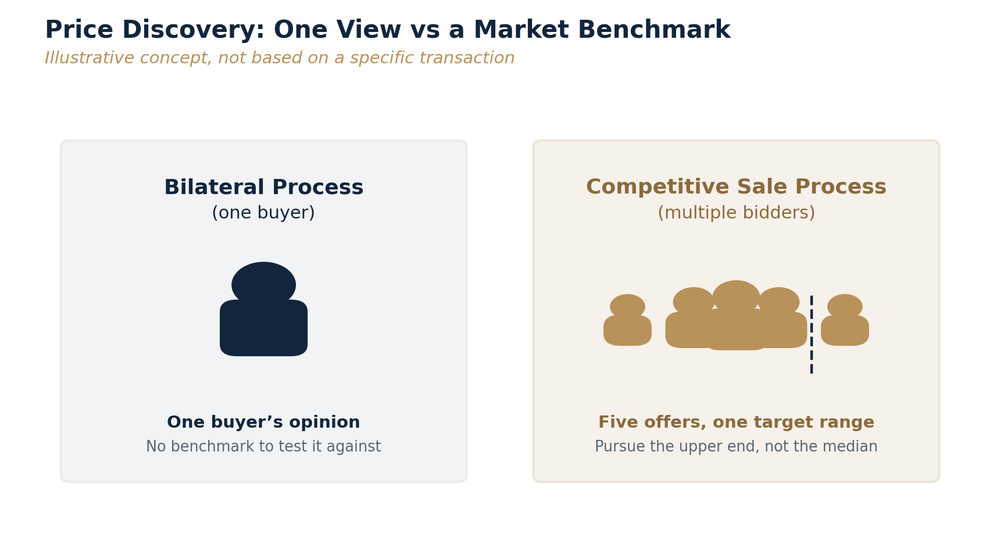
Multiple offers also provide a true market benchmark. One offer indicates what a single buyer is prepared to pay under their own assumptions. Three or four comparable offers establish genuine price discovery, enabling negotiation from strength.
The chart below shows this pattern using a common way of comparing business values: the EV/EBITDA multiple, where EBITDA is a standard measure of a company's underlying profit and the multiple is how many times that profit a buyer is prepared to pay. In our experience with mid-market companies, businesses that settle at 10x EBITDA in a bilateral process typically achieve 12x to 15x in a competitive sale process. This premium is driven entirely by buyer competition rather than changes in company fundamentals. For sector context on where those multiples sit today, see our valuation multiples by sector.
20–50% the typical uplift in EBITDA multiple achieved through a competitive sale process (12x–15x) versus a bilateral process (10x).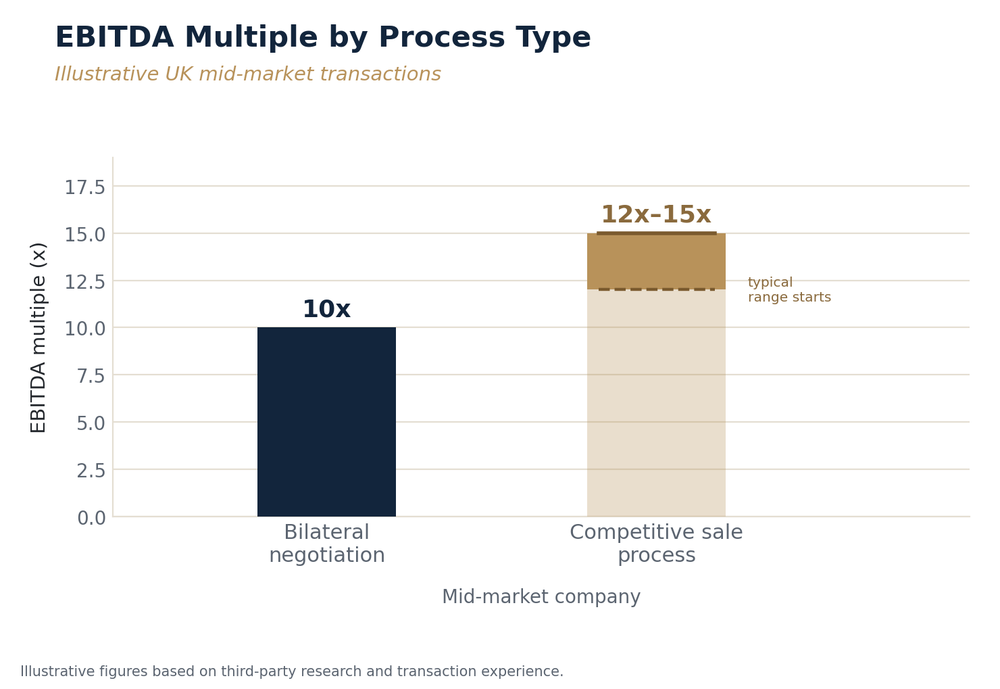
Reading the buyer and expanding the field
Aggressive and conservative bidders present distinct risk profiles. Aggressive bidders often offer high initial indicative values to secure exclusivity, then attempt to chip away at price during diligence once the seller is committed. Conservative bidders open lower but maintain their position with greater discipline. Identifying these profiles early dictates timeline design, diligence access and reserve buyer retention.
Widening that buyer pool matters just as much as reading it correctly. Domestic-only processes risk missing overseas trade buyers and private equity sponsors who view targets through different valuation multiples due to currency dynamics, strategic scarcity or geographic expansion goals. International buyers account for the majority of UK M&A activity by value; introducing well-matched overseas acquirers through an advisory network significantly elevates valuation ceilings.
How Deal Ascent delivers premium valuations
When an unsolicited approach occurs, Deal Ascent transforms single enquiries into disciplined, competitive outcomes:
- Vetting approaches: assess buyer funding, protect key relationships, and construct controlled processes around initial offers.
- Reading bidders: gauge buyer urgency early to establish tailored timelines and exclusivity terms.
- Creating tension: introduce targeted strategic and financial buyers globally to force original approachers to compete.
- Enforcing discipline: implement short exclusivity windows and mandatory price-reconfirmation milestones to prevent price erosion.
- Driving completion: manage bid comparisons, sale and purchase agreement negotiations and due diligence execution to lock in maximum market value.
- Protecting operations: handle transaction execution so management remains focused on running the core business.
For a fuller explanation of how a sale is run end to end, see our M&A sale process and What Is My Business Worth?
Frequently asked questions about unsolicited approaches
What should I do if a buyer approaches me directly about acquiring my business?
Stay courteous, do not name a price, and do not sign anything — including a non-disclosure agreement or exclusivity — before taking advice. Invite the buyer to set out their indicative view of value and rationale first, then route the conversation through advisers so the approach can be converted into a competitive process rather than a private negotiation.
Should I name a price when a buyer asks what I would sell for?
No. Whoever names a figure first hands the other side an anchor. Quote too low and you set a ceiling before due diligence has even started; quote too high without support and you lose credibility. Ask the buyer for their indicative valuation and the reasoning behind it before discussing any number of your own.
Is a bilateral negotiation worse than a competitive sale process?
Usually, yes. In Deal Ascent's experience, due diligence in a bilateral deal takes roughly 1.5 to 2.5 times longer, more than 90% of live bilateral deals pick up price erosion or late-stage purchase price adjustments, and more than half of bilateral negotiations fail to close outright. A competitive process preserves the alternative that keeps a buyer disciplined.
How much more can a competitive sale process achieve?
In our experience with mid-market companies, businesses that settle at around 10x EBITDA in a bilateral process typically achieve 12x to 15x in a competitive sale process — an uplift of roughly 20% to 50%, driven by buyer competition rather than any change in company fundamentals.
How long should an exclusivity period be?
Four to six weeks is preferable to the eight to twelve weeks buyers typically request. A shorter window maintains momentum and limits how long a single buyer can sit on the deal without competitive pressure. Requiring the buyer to reconfirm the headline price in writing at set intervals, with any downward move ending exclusivity, protects against late chipping.
How do I turn down an approach without damaging the relationship?
Thank the buyer for the interest, explain that any conversation about the future of the business will run through your advisers alongside other relevant parties, and invite them to participate on that basis. Buyers remember how a process is handled; a courteous pivot keeps them in the field rather than closing the door.
Confidential consultationReceived an unsolicited approach?
If a buyer has reached out, or if you are considering how to respond, now is the time to obtain an independent evaluation before any figure is discussed. We assist in evaluating genuine buyer intent, determining process strategy and generating the competitive tension required to secure optimal terms — in complete confidence and with no obligation.
This article is intended for information purposes only and does not constitute financial, tax or legal advice. Statistics reflect Deal Ascent's transaction experience and third-party research; outcomes vary by sector, deal size and process quality.